
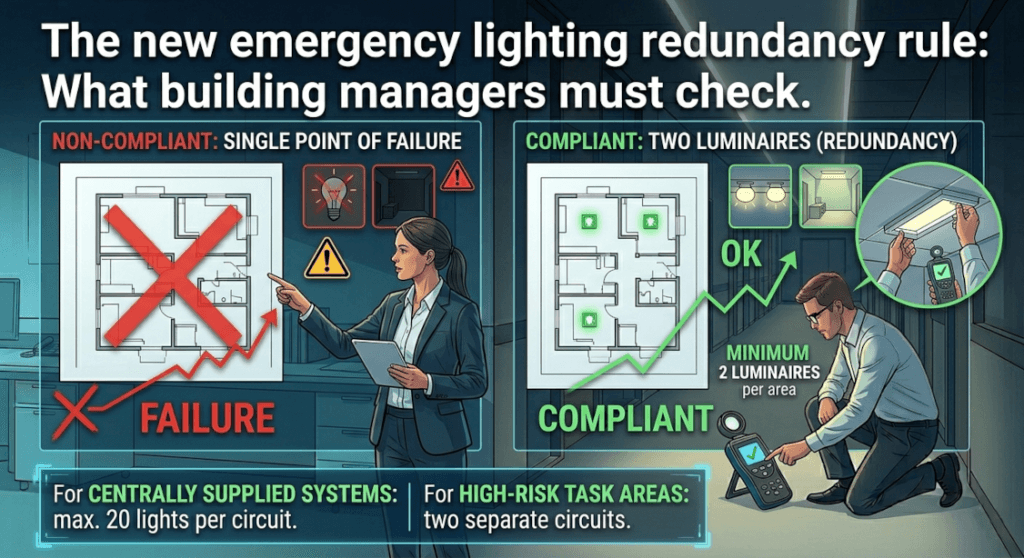
The new redundancy rule for emergency lighting
Summary
No Single point of failure.
At least 2 luminaires in every room.
High risk / critical areas. Extra circuits.
Even a circuit failure shouldn’t put the area in darkness
Check on next inspection.
Check and record your findings. Put a plan of action together.
It is a scenario easy to overlook. You have emergency lighting installed, it passes its monthly test, the annual discharge goes without a hitch, and your compliance records are in order. Then, in a real emergency, a single luminaire fails — and part of your escape route goes dark.
Under the previous emergency lighting standard, this was a gap that building design did not always formally address. Under BS 5266-1:2025, it is closed. The updated code of practice, which came into force in October 2025, introduces a specific requirement: every room and escape route must be covered by a minimum of two luminaires.
The principle is straightforward. No single point of failure should be able to leave an area in total darkness.
What the standard actually says
Clause 6.3 of BS 5266-1:2025 sets out the requirement directly. At least two luminaires — or emergency exit signs fitted with downward illumination — must cover each room and each escape route. If one fails, the other maintains some level of illumination. Occupants are not left in complete darkness while trying to find their way out.
This sits alongside a related circuit-level rule introduced in the same standard. For centrally supplied systems, a single electrical fault on a final circuit must not affect more than 20 luminaires.
In high-risk task areas, the requirements go further still — dual circuit supply from at least two separate circuits is required, so that even a circuit failure cannot extinguish all the lighting in a critical zone.
Together, these rules represent a significant shift in how emergency lighting systems are expected to be designed. Resilience is no longer just about battery duration and lux levels. It is about ensuring the system as a whole can absorb a failure and keep people safe.
Why this matters for existing buildings
Many emergency lighting installations across the UK were designed to an older standard. In smaller rooms, short corridors, and simple layouts, a single luminaire was often considered sufficient — it met the illumination requirements, it activated on power failure, and it passed every test it was put through.
Under BS 5266-1:2025, that approach is no longer compliant. A room with one emergency luminaire, however well-positioned, does not satisfy the minimum two-fitting requirement. A short corridor served by a single bulkhead fitting at one end presents the same problem.
For responsible persons carrying out reviews against the new standard, this is likely to be one of the more common gaps identified — particularly in older office buildings, small commercial premises, and residential common areas that have not been significantly upgraded in recent years.
What a compliant system looks like
The two-luminaire rule does not mean every fitting needs to be duplicated regardless of layout. It means that no single area that requires emergency lighting should rely on only one source of illumination. In practice, this often comes down to how luminaires are positioned and spaced.
A well-designed system will distribute fittings so that the failure of any one luminaire still leaves adjacent fittings capable of providing some illumination across the affected area. In longer corridors, this is usually straightforward — luminaires positioned at intervals naturally provide overlap. In smaller rooms or awkward layouts, it requires deliberate planning.
For centrally supplied systems, the circuit design matters as much as the luminaire placement. Grouping too many fittings on a single circuit creates a different kind of single point of failure — not a lamp failure, but a wiring fault that could take out a large section of the system at once. The 20-luminaire limit per circuit is a direct response to this risk.
Recommended products

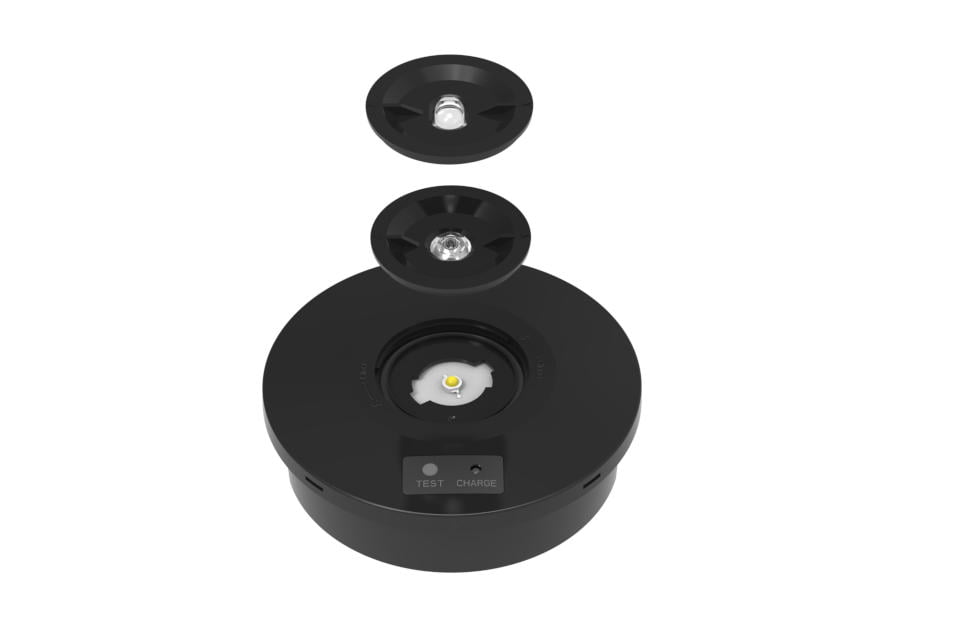
Escape Emergency Spot Round
Price range: £31.99 through £39.99
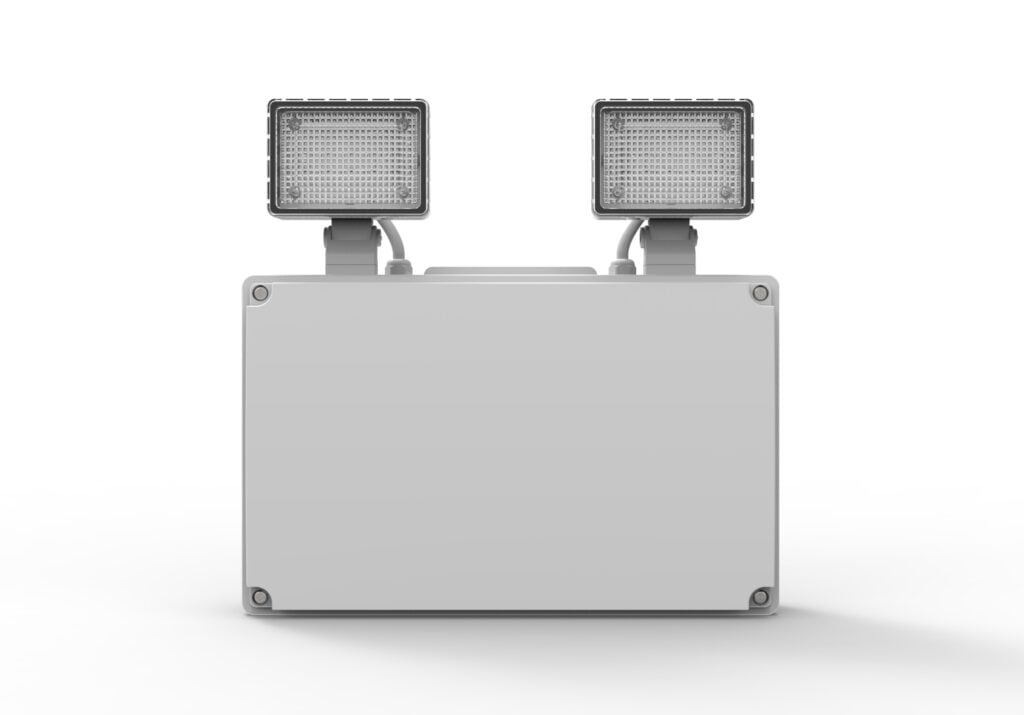
High Power LED Emergency Twinspot IP65
£59.99 (£71.99 inc VAT)
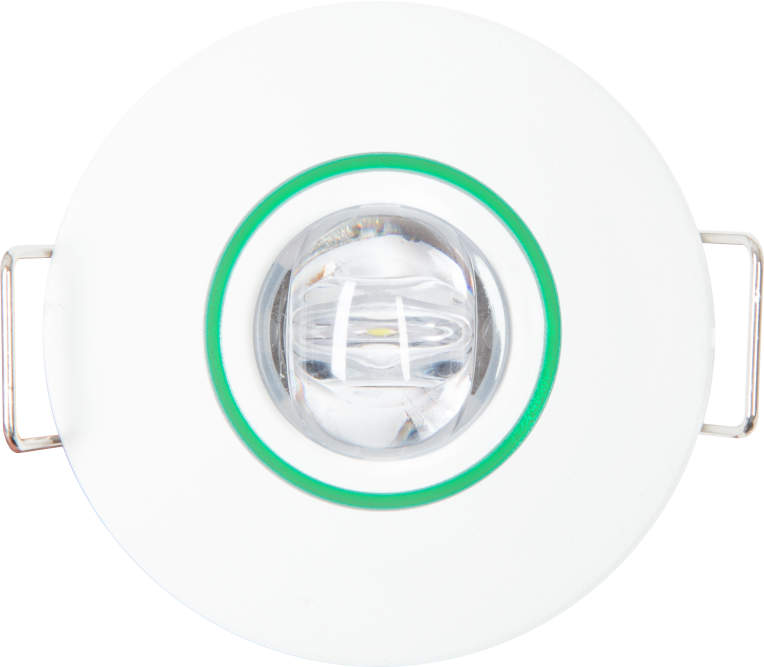
Recessed LED 3HR Down Light
Price range: £62.50 through £106.43
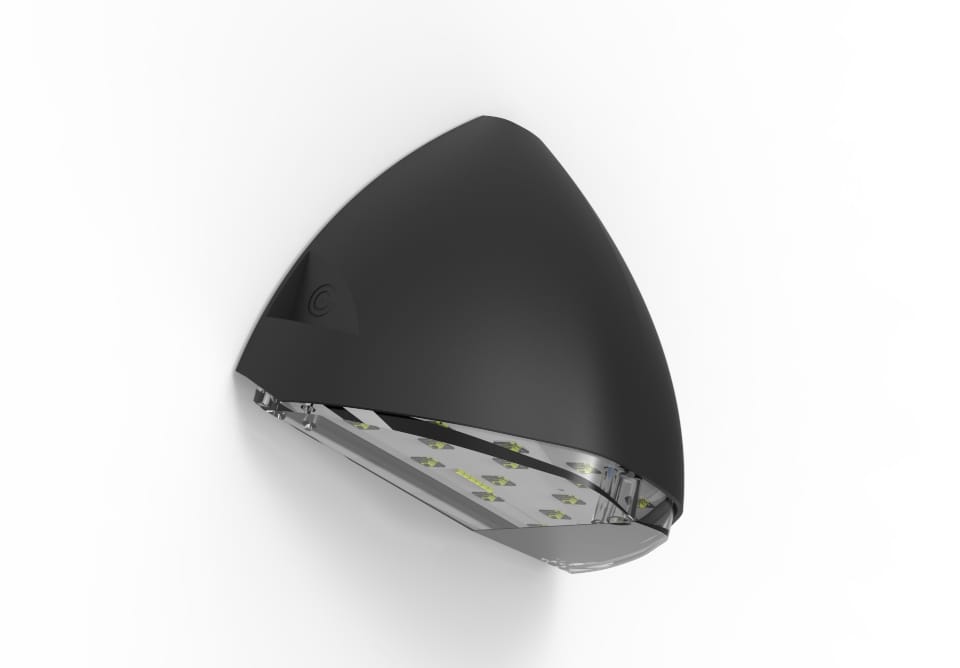
Shark Fin Emergency Outdoor Wall Light
Price range: £69.99 through £115.99
The broader picture
The two-luminaire requirement is one part of a wider emphasis on system resilience running through BS 5266-1:2025. The same update introduced full-width route illumination, five-yearly photometric verification, and stronger documentation requirements — all pointing in the same direction. A system that works on paper, passes routine tests, and still fails occupants in a real emergency is no longer an acceptable outcome.
For building owners and facilities managers, the practical implication is a review of existing layouts against the new standard. Where gaps are identified — single luminaires in rooms, isolated fittings in short corridors, circuits carrying more than 20 fittings — these need to be addressed, documented, and corrected as part of ongoing compliance.
The rule itself is simple. In an emergency, one light should never be all that stands between your occupants and darkness.