
Most building managers know they need to test their emergency lighting. The monthly flick of a test key, the annual three-hour discharge — these have been part of fire safety routines for years. But a new requirement introduced in 2025 adds a test that many properties have never carried out, and may not even know exists.
From BS EN 50172:2024 and the updated BS 5266-1:2025, photometric verification of emergency lighting systems is now required at intervals not exceeding five years. It is a more rigorous check than anything previously mandated — and it addresses a problem that routine testing simply cannot catch.
What is photometric verification?
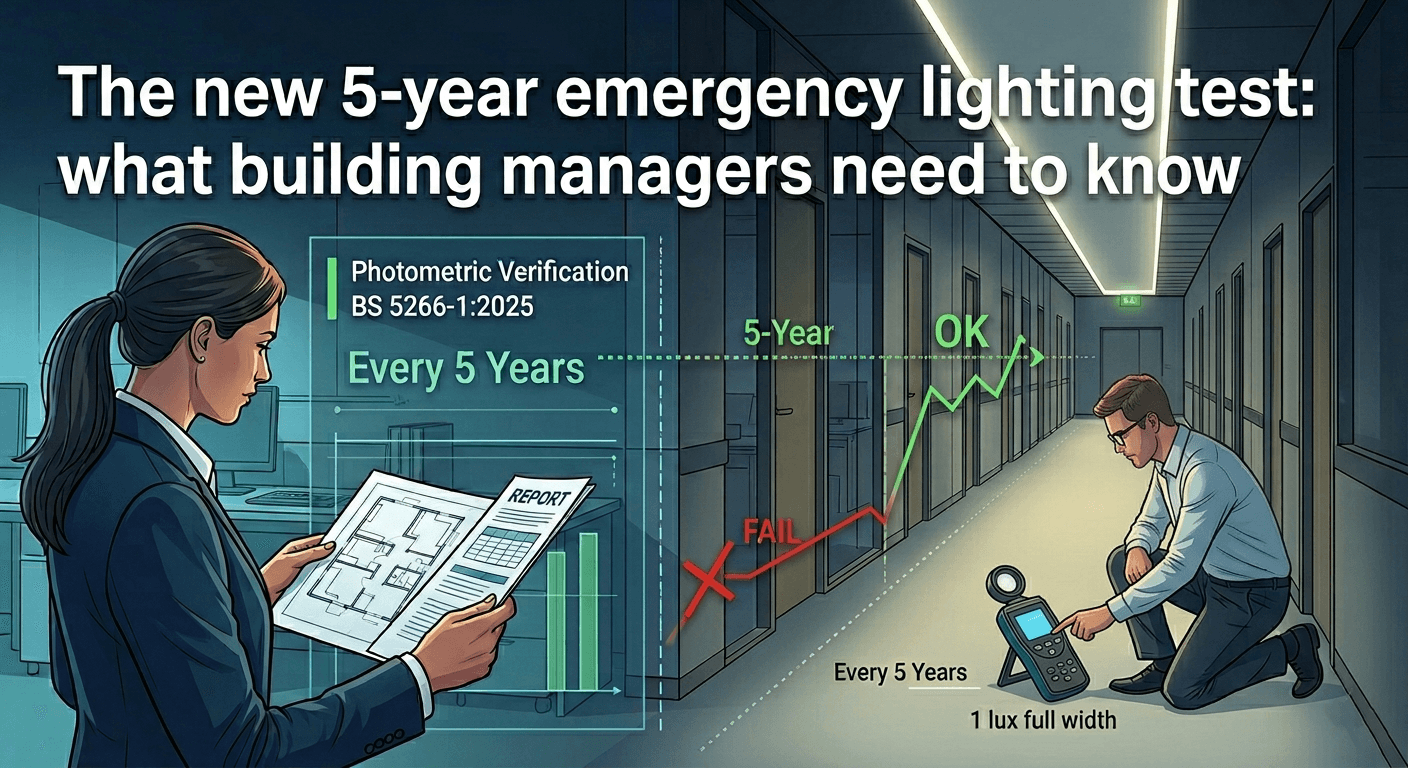
Photometric verification means physically measuring the actual light output of your emergency lighting system at floor level across all escape routes. Using calibrated lux meters, a qualified engineer takes readings at multiple points along each route and confirms that illumination levels still meet the legal minimums — 1 lux across the full width of escape routes, and 0.5 lux across open areas.
This is fundamentally different from the tests you already carry out. A monthly functional test confirms that luminaires activate when the mains supply is interrupted. An annual discharge test confirms that batteries hold charge for the required duration. Neither test tells you how much light is actually reaching the floor, nor whether it is reaching the right places.
Photometric verification answers the question that all other tests leave open: is your system still doing its job?
Why routine testing isn’t enough
Emergency lighting systems degrade in ways that are invisible to standard testing. For example LED output drops gradually over thousands of hours of use, diffusers and covers cloud with age, reducing light transmission or batteries lose capacity. Also buildings change E.G. new partitions go up, racking gets added in warehouses, suspended ceilings get modified. All of which can block or redirect light without anyone noticing.
A system that was correctly designed, properly installed, and fully commissioned a decade ago may no longer deliver adequate illumination today. It will still pass a functional test. The luminaires will still activate. The batteries will still run for three hours. But the light reaching the floor along the edges of your escape routes may have fallen well below the required standard.
This is precisely the scenario the five-year photometric verification is designed to catch.
What the test involves
The verification must be carried out by a competent person using calibrated measuring equipment. In practice, this typically means a qualified fire safety or electrical engineer rather than an in-house maintenance team.
During the assessment, the engineer will simulate emergency conditions — usually by cutting the mains supply. And then take lux readings at floor level at regular intervals along each escape route. Readings are taken across the full width of the route, not just the centre line. Reflecting the full-width illumination requirement also introduced in BS 5266-1:2025.
The results are compared against the design standard. Any areas falling below the required levels must be addressed . Whether through repositioning luminaires, replacing degraded fittings, or redesigning part of the system.
All results must be recorded and retained as part of the building’s fire safety documentation. BS 5266-1:2025 places increasing emphasis on audit trails, logbooks and inspectors will expect to see photometric records alongside the routine test logs.
When does the clock start?
The five-year cycle should begin from the date of commissioning for new installations, or from a baseline verification for existing systems. If your emergency lighting has never had a photometric assessment carried out. The practical answer is to arrange one now and use that as your starting point.
For older systems that have not been assessed in some time; the verification may also bring to attention equipment that is due for replacement. Making it a useful maintenance tool as well as a compliance obligation.
Who is responsible?
As with all emergency lighting obligations, the duty falls on the responsible person. This is typically the building owner, employer, or managing agent. The Building Safety Act has since strengthened personal liability in higher-risk buildings, making compliance documentation more important than ever.
Ignorance of the new requirement is not a defence. Fire and Rescue Services enforcing against non-compliant premises will reference BS 5266-1:2025 as the current standard of practice.
A practical next step
If your building’s emergency lighting records do not include a photometric verification, that is the gap to address. When commissioning the work, confirm that the engineer will be measuring to the full-width standard introduced in 2025. Not just centre line readings, which reflect the older approach.
The test itself is not disruptive, but it does require access to all escape routes and a temporary interruption to the mains lighting supply. For occupied buildings, it is worth scheduling during lower-occupancy periods.
The five-year photometric check is one of the more substantive additions to UK emergency lighting law in recent years. It exists because good intentions and working batteries are not the same thing as adequate illumination. For building managers who take compliance seriously, it is also a genuine opportunity to confirm that the system is performing as it should.