
Emergency lighting isn’t the most glamorous part of a building’s electrical setup. It’s also one of the few systems that only gets noticed once something has already gone wrong. A fault, a fire, a power cut in the middle of a busy shift. That’s the moment your emergency lighting either does its job or doesn’t.
The trouble is, a surprising number of installations fall short, not because anyone’s being careless, but because a handful of mistakes crop up again and again. Here are five mistakes in emergency lighting, and how to avoid them.
Mistake 1: Ignoring Regulations
The UK’s emergency lighting requirements sit across a few different documents, and it’s easy to lose track of which one applies where. The core code of practice is BS 5266-1:2025, which replaced the 2016 edition in October 2025 and now covers emergency escape lighting, local area lighting, and standby lighting rather than just escape routes. It works alongside BS EN 1838:2024 and BS EN 50172:2024, the European standards covering performance and system requirements. All three sit underneath the legal duties in the Regulatory Reform (Fire Safety) Order 2005 in England and Wales. For higher-risk buildings, the Building Safety Act 2022 also applies.
Getting this wrong isn’t a paperwork issue. If a building is inspected, or worse, if there’s an incident, the “responsible person” has to show their working. That’s usually the building owner or duty holder. They’ll need to prove the fire risk assessment was done properly and the lighting meets current standards. Relying on an old edition of BS 5266-1, or assuming a system installed years ago is still compliant, can leave a business exposed to enforcement action, invalidated insurance, or worse if someone’s hurt during an evacuation.
Before you install anything:
- Confirm you’re designing to BS 5266-1:2025, not the withdrawn 2016 edition.
- Check the building’s fire risk assessment to understand what’s actually required for that specific premises.
- If you’re not confident interpreting the standard, a Third-Party Certificated provider (BAFE SP203-4, for example) can confirm the classification and design before work starts.
Mistake 2: Wrong Location for Installation
Even fully compliant equipment fails if it’s fitted in the wrong place. Emergency lighting needs to follow the logic of how people actually move through a building during an emergency, not just where it’s convenient to run a cable.
Areas that get overlooked more often than they should:
- Changes of direction and floor level, such as stairwells and corridor junctions
- Final exit doors and the immediate area outside them
- Toilets and other enclosed spaces without natural light
- Plant rooms, switch rooms, and areas housing firefighting equipment
- Lift lobbies, even where the lift itself isn’t part of the escape strategy
As a general rule, place fittings at escape route junctions, changes of direction, stairs and exits. Add them near fire safety equipment like call points and extinguishers, then check the whole route for gaps. BS 5266-1:2025 also confirms that borrowed light, meaning light spilling in from an adjacent room normal lighting, can’t be relied upon to meet requirements. Every relevant space needs its own coverage. Read More
Mistake 3: Choosing Inadequate Equipment
Not all emergency lighting is created equal, and specifying the wrong fitting is one of the easiest ways to end up with a system that’s compliant on paper but underperforms in practice.
Light output matters more than it might seem. BS 5266-1:2025 sets clear minimums. Escape routes need a minimum of 1 lux, and under the new rules this now applies across the width of the route rather than just the centre line.
BS 5266-1:2025 sets clear minimums:
- Escape routes: at least 1 lux, now across the width of the route rather than just the centre line
- Open areas: 0.5 lux at floor level
- High-risk task areas: 15 lux or 10% of normal lighting, whichever is higher
A fitting that looks adequate on a spec sheet can still leave dark patches if it’s underpowered for the space or spaced too far from its neighbours.
There’s also the question of maintained versus non-maintained systems:
- Non-maintained fittings only come on when mains power fails. They’re the standard choice for most escape lighting.
- Maintained fittings are on whenever the normal lighting is on, and stay lit if mains power fails. These suit venues where people may not know the space well, such as cinemas, theatres, and some retail environments, where a light that’s already on removes any delay in orientation.
When selecting fittings, think about the building’s use first. A warehouse with racking and machinery needs different light distribution to an office corridor. A building with sleeping accommodation, such as a hotel or care home, always needs a 3-hour duration, because occupants can’t be relied on to evacuate immediately. Battery chemistry matters too, since NiCd, NiMH, and LiFePO4 batteries all age differently and this affects how long a fitting will genuinely perform before it needs replacing.
Mistake 4: Lack of Regular Testing and Maintenance
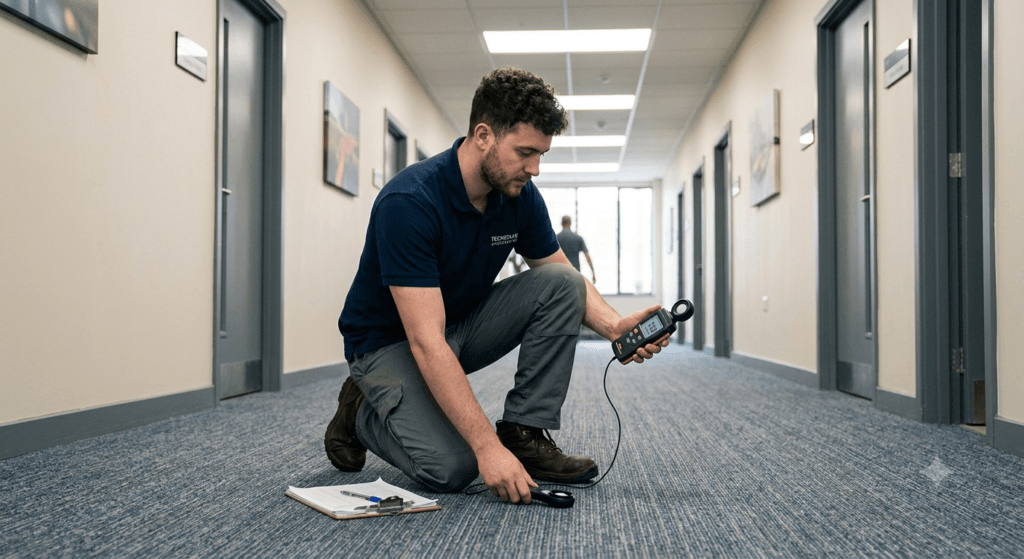
An installation that’s designed and fitted correctly can still fail if it isn’t tested. Batteries degrade, LEDs fail, and faults in central systems can go unnoticed for months without a proper testing regime.
BS 5266-1:2025 keeps the testing structure most installers will already be familiar with, but it’s worth restating clearly:
Basic maintenance checklist:
- Monthly: A brief functional test of every luminaire and exit sign, simulating a mains failure and confirming each one lights up correctly. This only needs to run for a few seconds per fitting.
- Annually: A full-duration test, running the system on battery power for its full rated duration. That’s 3 hours for most installations, or 1 hour in limited cases. Every luminaire should stay lit throughout.
- Every 5 years: Photometric verification, a newer requirement under the 2025 edition, which checks actual light output and distribution against the original design rather than just whether the fittings switch on. Read more
- Ongoing: Logging every test, fault, and repair in a logbook, and getting any failed component fixed by a competent person promptly.
Where possible, schedule testing for quiet periods or when the building is empty. After a full-duration test, batteries need up to 24 hours to recharge, so plan around that.Skipping or rushing this routine is one of the most common reasons a system that was compliant on day one quietly stops being compliant a year or two later.
Mistake 5: Poor Documentation and Certification
This one’s easy to overlook because it doesn’t affect whether the lights work. It affects whether you can prove they work, and increasingly under BS 5266-1:2025, that distinction matters.
The standard puts more weight than before on clear records: design intent, the reasoning behind fitting selection and placement, commissioning certificates, and a running log of every test and repair. Without this, a building owner can’t demonstrate due diligence if the system is ever questioned. That might be during a routine audit, an insurance review, or an investigation after an incident.
Good practice here is straightforward:
- Keep a dedicated logbook (physical or digital) covering design, installation, and every subsequent test.
- Retain commissioning certificates and any photometric verification reports.
- Make sure records are accessible to whoever holds responsibility for the building, not filed away with the original installer and forgotten.
- Where work is carried out by a Third-Party Certificated provider, keep evidence of that certification alongside the system documentation.
The Bottom Line
Most emergency lighting failures don’t come from dramatic errors. They come from small gaps: an outdated standard, a missed corner of the building, a fitting that’s slightly underpowered, a test that got skipped, or a logbook that’s gone missing. Getting the fundamentals right at installation, and keeping on top of testing and records afterwards, is what actually keeps a system doing its job when it matters.